Gut Monitoring "Smart Pill" Testing Advances
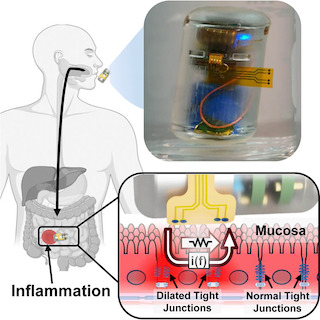
University of Maryland (UMD) researchers are making progress on ingestible capsule technology designed to make gastrointestinal (GI) disease diagnosis less invasive and more accessible. From step forwards in testing to new mechanisms, the gut monitoring “smart pill” is now closer to providing an alternative to invasive techniques like endoscopies when monitoring gut health by autonomously detecting early signs of disease and monitoring tissue health.
“These advancements represent an important step toward autonomous ingestible biopsy systems that could one day reduce the need for conventional endoscopic biopsies,” said UMD Distinguished University Professor Reza Ghodssi. “The work highlights how advances in microsystems engineering and additive manufacturing can unlock new capabilities for biomedical devices. We're excited about the potential for smart ingestible technologies to transform the diagnosis and monitoring of GI diseases.”
Inflammatory bowel diseases (IBDs), such as Crohn’s disease and ulcerative colitis, are among the most prevalent GI disorders. Traditional endoscopies allow diagnosis through visualization but are highly invasive and only effective when symptoms worsen.
“In vivo monitoring of tissue permeability in a rat colitis model via a bioimpedance-sensing ingestible device” outlines new data that shows GI inflammation can be detected using bioimpedance, a measure of how easily ions pass through intestinal tissue. Capsules can wirelessly monitor this permeability, providing a noninvasive path toward diagnosis. The paper is available to read online through Cell Press’ Device journal.
It was written by Mateo W. Lim (ECE/ISR/Fischell Institute), Hammed Ayansola (Animal & Avian Sciences), Justin M. Stine (MATRIX Lab), Julie M. Karasik (BIOE), Younggeon Jin (Animal & Avian Sciences), and Reza Ghodssi (ECE/ISR/Fischell Institute/MATRIX Lab).
More information can be found on the UMD ECE News (10 - August / 2026)