Sensor Advancement Breaks Barriers in Brain-Behavior Research
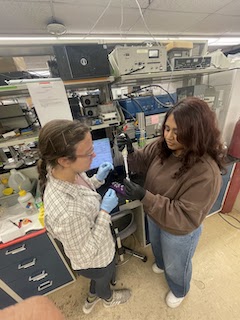
New, interdisciplinary research from the University of Maryland (UMD) A. James Clark School of Engineering and the UMD College of Behavioral and Social Sciences is opening the door to better understanding the relationship between neurohormones and behaviors. The team proved that a newly improved electrochemical sensor can reliably measure serotonin levels in crayfish blood and found that serotonin levels changed when the animals experienced different social situations. A paper detailing the study, “Electrochemical sensing of hormonal serotonin levels in crayfish,” is now available online and will be published in March 2026 in the journal “Biosensors and Bioelectronics: X.” It was written by Sydney N. Overton (ECE, ISR, Fischell Institute, MATRIX Lab), Kanishka Balamurugan (PSYC, NACS), Jens Herberholz (PSYC, NACS), and Reza Ghodssi (ECE, ISR, Fischell Institute, MATRIX Lab).
“This impressive breakthrough in sensor development will lead to major advancements in brain-behavior studies and highlight the significant discoveries that can be realized when engineering and behavioral sciences experts work together,” said Dr. Ghodssi, UMD Distinguished University Professor and MATRIX Lab Executive Director of Research and Innovation. “We thank Biosensors and Bioelectronics: X for recognizing this great milestone in our research."
The study demonstrates that the improved electrochemical sensor can be used to answer real biological questions related to how hormones change over time and how neurochemistry and behavior are connected. It also sets researchers up for future success in studies related to mental health, stress, and social behavior. In the future, the sensor could be integrated into a wearable system. This would allow for real-time serotonin monitoring, a big step toward understanding how hormones fluctuate during behavior and how outside forces alter neurochemistry.
More information can be found on the UMD ECE News (13 - January / 2026)